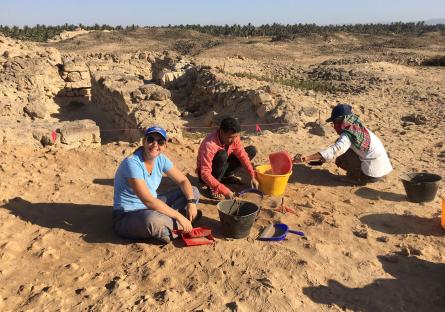
Estrella Mountain Community College (EMCC) is offering a new study abroad program this summer! In May, EMCC faculty will take up to 30 students to Oman, where they will investigate archaeological sites at Al Baleed and Shisr, two historically significant locations, where EMCC Anthropology Professor Dr. Kristy Miller has conducted research for years.
“It has been a dream for a while,” Dr. Miller said. “I have been talking about taking students from EMCC to Oman for years, but I was adjunct faculty until 2024-25 and not eligible. As soon as I accepted the residential position, I started researching how EMCC could become involved in study abroad.”
Dr. Miller was introduced to Oman during a study abroad program as a senior at Southwest Missouri State University. It was the first time she’d left the country. Later, in 2013, she became the Lab Director and Assistant Field Director for the UNESCO World Heritage Site of Al Baleed in Salalah, the capital city of southern Oman’s Dhofar province. She traveled to the site once or twice a year to excavate, but the pandemic shut down the 2020 field season, and during that time, the country underwent many changes.
“Sultan Qaboos (the king) passed away, and after that, several of our liaisons and contacts retired or moved to other positions,” Dr. Miller explained. “The emphasis in Oman shifted away from archaeology, and we have not excavated since. But I returned in May of 2025 to do some initial work with the collections and help put a proposal together to update the Visitor Center at Shisr.”
Accompanying Dr. Miller on this summer’s study abroad program will be EMCC Biology Professor Scott Milne, a fellow world traveler who has also been to Oman.
“After some discussion of how well biology would fit with the archaeology, I officially asked him to be my co-faculty, and we were lucky to get college approval relatively quickly,” Dr. Miller said.
Professor Milne has only spent about 24 hours in Oman as part of a trip to Egypt, but he said he was still hugely impacted by his short stay.
“Oman is beautiful, the people are friendly, and there is so much to explore,” he said. “I am looking forward to learning more about the archaeology and anthropology side of things — I have always thought if I didn’t study biology, I would have studied arch/anthro! So I am excited to see how we can connect the concepts and build some unique opportunities for students.”
One of those students is Maha Al-Haraz, who began attending EMCC about a year ago. She learned about the study abroad program last fall when she saw a flyer in Professor Milne’s Environmental Biology class.
“I remember taking a picture of the flyer and showing it to my family as soon as I got home,” she said.
In that same classroom, she learned about a way to help defray her costs to study abroad — the Gilman Scholarship. The U.S. Department of State’s Benjamin A. Gilman International Scholarship Program provides up to $5,000 in merit-based scholarships to outstanding American undergraduate students with high financial need to pursue credit-bearing academic studies and career-oriented internships abroad.
“Since Professor Milne already knew I was interested in the study abroad program, he offered to help out with any questions I had while applying for the scholarship,” Maha said.
More than 7,700 students, including six from EMCC, applied for the Gilman scholarship last fall, a record high for the application cycle. More than 1,500 scholarships have been awarded so far to students from all 50 states, the District of Columbia, Puerto Rico, and the Northern Mariana Islands. Two of those scholarships have gone to EMCC students. Spoiler alert: Maha is one of them.
“The scholarship I received will nearly cover the entire trip,” Maha said. “Without it, I would have had a bit of a harder time figuring out how to go. I am beyond thankful that I ended up getting the scholarship. It helped make me feel this study abroad program was feasible for me.”
The English Literature major has frequently visited the Middle East — her parents were born in Iraq, and most of her family still lives there — but she has never been to Oman, a place she’s always wanted to see.
“I can’t wait to learn more about the culture in Oman and about the history,” Maha said. “But there are a lot of different reasons that I was interested in this study abroad program. I plan to minor in communications once I transfer to a university, and I believe this will help me build skills in knowing how to work with different people, and in adapting to different environments.”
Maha and her cohorts will spend May 19 to June 7 in Oman, focusing on artifacts that were excavated from 2013 to 2019. They will sort, identify, photograph, and analyze the finds from Al Baleed.
“We plan to look at pottery, animal bones, and what we call special finds — weird things that need another look,” Dr. Miller said with a laugh. “The animal bones will tie to some of Professor Milne’s lectures on past and present sustainability and land uses. We will look at the biodiversity that used to be at the site compared to what it looks like now.”
On the bio side, the students will be comparing things such as sustainability, land use and change, and habitat connectivity in the ecosystems of the Arabian Peninsula to those in the American Southwest.
“Much of this will integrate information from Dr. Miller’s dig sites,” Professor Milne said. “Some of it will be unique to the landscapes and ecosystems of Oman. The goal is for students to get a comprehensive view of how humans and flora/fauna interact with and adapt to the conditions of arid biomes, such as the Arabian Peninsula and the Southwest.”
The students will be enrolled in ASB 222: Buried Cities, Lost Tribes: Old World, and BIO105: Environmental Biology for a total of seven credits during the study abroad program.
“There is class time as well as field time,” Dr. Miller said. “We are hoping to partner with Dhofar University and use one of their classrooms for lectures and work with them and their students on a couple of projects. We will also be in a classroom at the Land of Frankincense Museum, where we will both lecture and sort artifacts. They will get the same curriculum as if they were at EMCC, just in a different format.”
Both Professors have taught Flex Classes, EMCC’s condensed eight-week courses, and even four- to six-week summer courses. They’ve also taught the courses they will be teaching during the study abroad program multiple times over the years. So, Professor Milne said, “It won’t be that different.”
“I have probably taught ASB 222 40 times over the years,” he said. “We are both very familiar with the courses and can easily adapt them to the shorter time frame. The best part is that it will be so much more hands-on than we get to do in the classroom. Instead of showing photos, we will walk over the actual land!”
The students will also go on an overnight excursion, where they will see an archaeological site and learn about traditional camel herding, and they’ll take a field trip to the Rub al Khali (Empty Quarter) sand desert and the archaeological site of Shisr.
“We have a few other field trips planned for other biodiverse areas such as the beach, some baobab trees, ains and wadis (rivers and dry river beds), and a few other surprises for the students,” Dr. Miller said.
EMCC students still have time to apply for the study abroad program and the Gilman scholarship! Applications for the study abroad program are due by March 2, and applications for the Gilman Scholarship are due by March 5. A study abroad info session is set for 3:30 p.m. on Feb. 18 in Arroyo 269. Learn more and apply at https://www.estrellamountain.edu/academics/classes/study-abroad.